INTRODUCTION
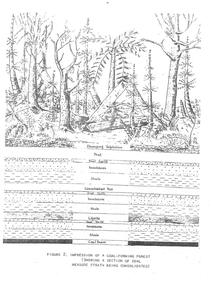
The coal which we mine and prepare today was formed about 300 million years ago, towards the end of a period of time which geologists call, appropriately, the Carboniferous Period which began about 350 million years ago, and which lasted about 80 million years. In other parts of the world the coal seams may be as old as 300 million years or as “young” as 30 million years but these are not of interest to us here. The following is an account of how the coal seams were formed. The trees, some of which were over 100 feet high, grew in vast swampy forests amidst dense undergrowth of fern-like plants. When this vegetation died, it suffered decay and chemical change. Under water, and became changed into peat. Lesson 1 Fig. 2 gives an impression of how part of a forest swamp might have appeared during coal forming times.
(ii) Coal Formation
The forest growth was interrupted from time to time by subsidence of the swamp areas. This sinking of the “floor” of the swamps caused areas to be flooded, killing the plant life; lagoons or even seas were formed where forests once grew. The silt, sand and other matter carried by the rivers (similar to the way in which a trough washer or launder carries coal and shale) fell out of suspension when the rivers slowed down on reaching these “seas.” Thus, the forests were gradually covered with mud and sand. This sort of action can be seen taking place today at any river mouth. For example, the “sand bars” of a river are partially caused by the sediment being carried down by the river and dropped where the river slows down on meeting the sea.
These sediments continued to pile up on top of the peat and cause it to become more and more compressed under the increasing weight of the deposits. This pressure was partially responsible for squeezing gases and moisture out of the peat and making it undergo chemical change. It also caused the peat to become harder and harder until eventually it became coal. This action is illustrated in Lesson 1 Fig. 2. Heat was also present, as will be described later, and this assisted the transformation.
Theories of deposition of coal
There are several theories relating to the deposits of coal, the two most important ones being the “drift” and the “in situ” theories. Probably both played a part in forming our coals.
“Drift” theory
According to the “drift” theory the trees and other plants which grew on land areas were at times of flood carried by the rivers down to the lakes where they formed coal.
“In situ” theory”
The “in situ” theory supposes that the trees and other plants grew in shallow swamps and fell, accumulated and decayed on site, thus forming the coal seam where the original forests had grown. Most of our coals have been formed in this manner.
Formation of coal measure strata
Coal measure strata are not made up completely of coal. The coal occurs in seams between other types of rocks which are mainly shales and sandstones. In coal preparation, we have to separate these shales and sandstones from the coal itself. It will, therefore, be of value to have some idea of how they too were formed.
It was mentioned earlier that when the forests subsided different sediments were deposited, mainly as mud and sand, on top of the peat. The finer material was carried further out to sea than the coarser material. Therefore, fine mud was dropped in deeper water than the coarser sand, which was dropped near the river mouth. The river mouths were gradually pushed further and further out to sea, and so sand was deposited on top of the finer material which had been laid down in the deeper water. The deposits eventually silted up large areas and once again gave rise to swamps. Another forest then grew on soil formed from the material brought down by the river, and flourished until interrupted again by subsidence, the cycle started once more. This was repeated time and time again during the coal forming period, and so built up coal measure strata. The peat became coal and the mud, sand and soil became shale, sandstone and seat earth respectively, due to the ever increasing pressure from the material being deposite
| Distance from Surface |
Section of Present day Coal measure |
Made From |
At time ofDeposite |
| Coal seam 1 |
Vegetation |
Forest |
|
| Seat earth |
Soil |
Swamp |
|
| Sandstone |
Sand |
Shallow Water |
|
| Shale |
Mud |
Water |
|
| Subsidance Occurred Here |
|||
| Coal seam 2 |
Vegetation |
Forest |
Formation of coalfields
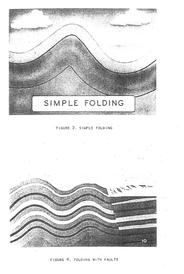
From the above descriptions we can visualize several hundred feet of strata, made up of coal seams and thicker shale and sandstone beds; all are reasonably horizontal, and undisturbed except for the continuously increasing vertical pressure caused by the weight of the strata above. However, the coal forming period ended with another type of disturbance; side pressures which caused the strata to fold. Lesson 1 Fig. 3 shows a section through typical coal measure strata which have been folded by the effects of the side pressures mentioned. Sometimes the forces exerted were so great that the strata fractured as well as folded by the effects of the side pressures mentioned. Sometimes the forces exerted were so great that the s trata fractured as well as folded, leaving what are known as faults. (Lesson 1 Fig 4)